
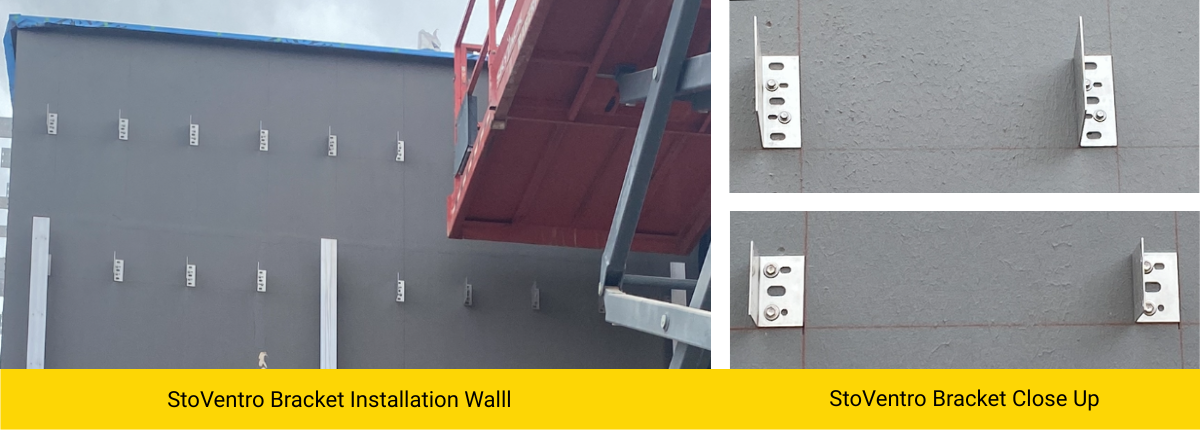
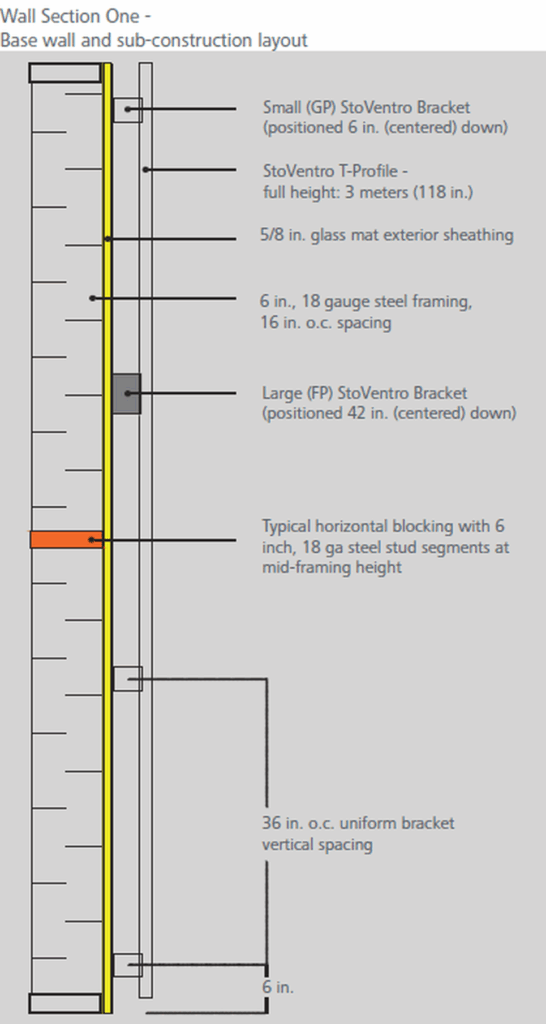
StoVentro™ is a bracket and rail rainscreen sub-construction that is thermally-broken, fully engineered, and tested to support a wide range of exterior cladding options, including StoVentec Fiber Cement, Render, Glass, and others. Prescriptive or pre-engineered layout options allow for some cost savings by providing a set script for certain wind load criteria. This is typically a 36-inch (914 mm) by 16-inch (406 mm) spacing of the brackets with T and/or L Profiles spaced at 16 inches on center. This configuration has been tested with StoVentec Fiber Cement panels to an ultimate wind load of 190 psf. Otherwise, project-specific engineering can tailor the system with wider or tighter spacings as needed to meet wind and dead loads. Zn-Al-Mg-coated steel (ASTM A1046-compliant), known by the tradename of ZAM® (by Wheeling-Nippon Steel, Inc.), is a material offering the strength of steel, improved thermal conductivity versus aluminum, and a modest cost increase above aluminum but well below stainless steel, while also offering outstanding corrosion resistance.
StoVentro brackets are offered in Zn-Al-Mg-coated steel, stainless steel, or aluminum options. There are benefits and tradeoffs to each. While aluminum brackets are the most cost-effective, aluminum is quite thermally conductive (210 W/m K) compared to stainless steel (17 W/m K) and therefore offers less optimized thermal efficiency. However, stainless brackets are significantly more expensive, so for projects not seeking the most stringent thermal efficiency targets, the aluminum brackets still offer good performance options at a lower cost. The Zn-Al-Mg brackets, with a thermal conductivity of 62 W/m K, offer a middle ground on cost and thermal performance. StoVentro has multiple in-depth third-party expert thermal analysis reports for each of its metal types. Detailed modeling and interpolations provide overall U-Factors and effective R-Values for numerous combinations of bracket spacings and insulation thicknesses. As a comparison between Zn-Al-Mg-coated brackets and aluminum ones, let’s examine an example StoVentro assembly configuration for its thermal efficiency:
| Metal Type | Horizontal Spacing (inches) | Vertical Spacing (inches) | Bracket Size and Insulation Thickness | Overall U-Factor Btu/h ft² F (W/m² K) |
Effective R-Value ft² hr F/Btu (m² K/W) |
|---|---|---|---|---|---|
| Aluminum | 24 | 36 | 120 mm/4 in.1 | 0.058 (0.33) | R-17.2 (3.03 RSI) |
| ZAM® | 0.055 (0.31) | R-18.2 (3.21 RSI) |
1Mineral wool exterior insulation with nominal R-Value of R-16.8 (2.96 RSI) and empty stud wall cavities.
In the above example, we see that ZAM brackets, in this case, actually improve the overall assembly Effective R-Value beyond the insulation alone due to the influences of the rainscreen air film, and improve the R-Value a full point above that offered by aluminum brackets. Refer to the StoVentro Thermal Analysis Reports for aluminum brackets and ZAM® for many other configuration ratings in order to optimize the system for performance and cost. Fewer brackets (i.e., wider vertical and/or horizontal spacings) improve thermal efficiency, but a balance must be struck to also meet wind and dead load design requirements for the claddings at a particular jobsite. Tighter bracket spacings needed for wind load ratings can be compensated for by increasing bracket depth and insulation thickness.

The corrosion resistance of ZAM-coated steel is perhaps its most impressive characteristic. Zinc, aluminum, and magnesium combine in a hot dip coating process to protect steel with unmatched corrosion resistance protection for non-stainless steel materials. Scratches or cut edges and perforations in ZAM-coated steel are protected as a fine zinc-based magnesium film flows over the cut edge. Any initial red rust that may appear at these locations will change to grey as the ZAM protection self-heals. StoVentro brackets with ZAM use a coating weight of ZM 115, equivalent to 1.15 ounces per square foot. When tested per ASTM B117 (Standard Practice for Operating Salt Spray (Fog) Apparatus) for 1,000 hours, no red rust was present. Comparatively, a sample of G90 steel (zinc galvanized with 0.9 ounces per square foot) was included in the test and suffered from significant red rust. Lastly, ZAM material is compatible for contact with aluminum parts, such as StoVentro T and L Profiles, without worry of galvanic corrosion problems.
See how StoVentro’s™ engineered sub-construction, available in aluminum, stainless, or ZAM® steel, supports your next rainscreen project.