
For EIFS and continuous insulation systems, attachment methods are often selected based on system requirements, substrate conditions, code requirements, and installation considerations. While both adhesive and mechanical attachment can be engineered to meet performance requirements, understanding how each method responds to wind loads, durability demands, constructability challenges, and aesthetic considerations can help inform better specification decisions.
Let’s dive into the details.
Wind-Load Resistance Comes from How Force Is Distributed
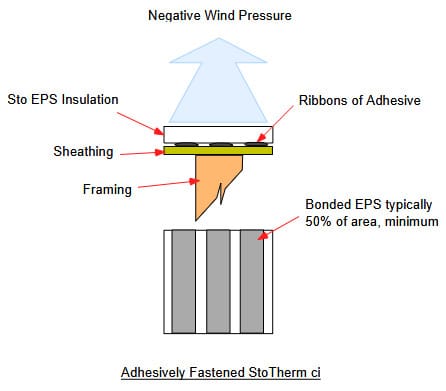
High winds hitting a building do more than just push on a wall. Wind pull-off or uplift, the vacuum force that tries to pull the outer walls off a building, is an issue to consider when choosing a fastening option for insulation. The difference between adhesive and mechanical in this case comes from how the force is distributed.
When adhesive is applied with a notched trowel, it covers approximately 30% to 50% of the insulation board surface, creating a large, continuous bond. This broad contact area helps distribute forces more evenly across the board, resulting in pull-off resistance of more than 15 psi and enhancing the overall durability and performance of the system.
For context, a 200 mph hurricane wind only exerts about 1 psi of pulling force on a wall. The adhesive option more than makes up for this load.
Mechanical fasteners, on the other hand, concentrate stress at specific points, where the screws and fasteners are. When the wind tries to pull the insulation off the wall, the force is applied to the washer around the screw head. If the force is strong enough, the insulation bond breaks around the washer.
The reality is that both options can be engineered to pass code; the difference comes in performance and durability.
Long-Term Durability Under Cyclic Loading

Now, let’s dive into the durability aspect. Enter cyclic loading.
Cyclic loading is structural fatigue caused by repeated, fluctuating forces, like wind loads on a system. Wind doesn’t just blow at a steady pressure or direction. It gusts, buffets and vibrates a building over and over. This adds up throughout a building’s lifespan.
Florida (especially Miami-Dade County) developed the toughest testing protocols for this in the country due to the high risk of tropical storms and hurricanes in that area.
To simulate hurricane conditions, here’s an example of the kind of testing they put a wall through using a specialized pressure chamber to rapidly pump air in and out:
- 600 cycles at 50% of the design wind pressure
- 70 cycles at 60%
- One cycle at 130%
Sto Corp.’s family of drainable, adhesively fastened systems (StoTherm ci) includes a subset of high-velocity hurricane zone (HVHZ) systems utilizing adhesively fastened assemblies that pass the stringent Miami-Dade County or Florida Building Product Approval requirements.
The results show the durability benefits of adhesive attachment in applicable StoTherm ci assemblies. While other Sto systems are engineered to meet performance requirements through mechanical attachment, adhesive fastening continues to prove to be the gold standard for StoTherm ci systems.
Construction and Cost Implications
The decision to use adhesive rather than screws is also supported by labor efficiency and costs.
Mechanical fastening involves many steps, most of which can be simplified or eliminated altogether by going the adhesive route.
- Layout and Attachment: Workers have to locate the studs behind the wall and screw the fasteners directly into them.
- Rasping: Most insulation boards have to be sanded or “rasped” to ensure a flat wall before applying the finish. This is impeded by hundreds of fasteners and washers, which can catch and damage rasping tools, slowing things down.
- Fastener “Spotting”: Workers have to go back and manually apply extra base coat cement to every single fastener to level the wall. This means more material and days of labor.
Contrast that with the adhesive process: you apply adhesive using a notched trowel, press it on the wall, and move on. No screws mean rasping is smooth and fast, and there’s no need to spot fasteners.
For many applications, adhesive installation is typically a faster and more uniform process. At the end of the day, it may be the more cost-effective option.
Aesthetic Implications

The following are aesthetic considerations involved with mechanical fastening that can be avoided with adhesive fastening.
- Ghosting: Screws conduct heat at a different rate than the surrounding insulation. On damp or frosty mornings, temporary “ghost circles” can appear on the facade where the screws are located. This is caused by the temperature difference and how dew or frost dries differently around these spots compared to the rest of the wall.
- Telegraphing: The extra base coat applied during the process of spotting mentioned above makes the cement layer thicker in those spots. Because thicker cement cures and holds moisture differently, subtle color variations may “telegraph” through the final finish paint after several wetting-and-drying cycles.
It’s important to note that these do not indicate a performance compromise. The building would still be perfectly safe and weather-tight even with these issues. These are just some things to keep in mind when choosing the attachment method on appearance-sensitive projects.
When Mechanical Fastening Is the Right Call
With all the above talk about adhesive over mechanical fastening in so many situations, it might be easy to assume we’re arguing that mechanical fastening is “bad.” But that’s not the case. Mechanical fastening is a proven and necessary solution for certain systems and cases.
One good example is StoTherm ci Mineral. Mineral wool insulation can be a highly desired insulation material due to its enhanced fire resistance and thermal and acoustical performance. Because it uses fibrous mineral wool, adhesive alone can’t securely hold its layers together. In this case, it must also be mechanically fastened.
Another example would be when local building codes or specific high-rise designs may also mandate mechanical fastening with no other option.
Additionally, adhesively applied systems should only be used when the surface is clean, dry, and free of all bond-inhibiting materials. Sheathing must be installed and protected in accordance with manufacturer’s and/or building code requirements. For concrete and masonry surfaces, the surfaces must be clean, dry and free of frost, damage, and all bond-inhibiting materials, including dirt, efflorescence, form oil and other foreign matter. Loose or damaged material must be removed by water blasting, sandblasting, or mechanical wire brushing and repaired. Applications over out-of-plane surfaces should be avoided. Surfaces should be resurfaced, patched and/or leveled with appropriate Sto leveling materials.
Ultimately, the choice between adhesive or mechanical fastening should depend on specific system requirements, not a one-size-fits-all approach. For expert guidance on specific projects, Sto’s technical team is a good resource to utilize before making a decision.
Adhesive is Engineered to Distribute, Not Concentrate
When it comes to fastening methods for StoTherm ci assemblies, the case for adhesive fastening is strong. Adhesive comes out on top across wind performance, durability, constructability and aesthetic considerations. That being said, mechanical fastening still remains an effective solution for certain systems and cases.
Ready to evaluate the complete engineering data behind these fastening methods? Check out the full Sto Tech Hotline 0409-E documentation for a deeper look at wind-load performance, or explore our advanced StoTherm ci Wall Systems to find the right assembly for your next project. For project-specific assistance, reach out to Sto’s expert technical support team here.