
Bond Failures Can Be Preventable
Here’s a scenario: a facade restoration which should have cost $300,000 and taken two months to complete, turns into a $700,000, two-year ordeal. All because a simple, low-cost test wasn’t done. The worst part? It could have been entirely prevented.
Successful recoating and restoration projects often depend on verification that the proposed new coatings will bond to the existing construction.
There are three field-testing methods available to evaluate bond performance. The key is choosing the right one to avoid wasting time and still mitigate risk.
For a complete technical breakdown on this, Sto® Corp offers Tech Hotline 0714-C, which includes full procedures on all field-testing methods. But if you’re looking for a bird’s eye view of what goes into field bond strength testing and sleeping soundly at night after a facade restoration project, read on.
What Field Bond Testing Actually Verifies
It’s important to remember exactly what is being tested and why. Field bond testing involves several critical aspects:
- Quality of substrate preparation: Applying a new expensive coating to an existing substrate covered in dust, oil, mold or chalky material is a recipe for disaster. Testing assesses whether the existing wall is sufficiently prepared for a new coating.
- Adhesion of a new coating to an existing one: Are the coatings adhesively compatible? Testing if the new coating will actually stick to the old one is critical to prevent restoration failures.
- Bond of a skim coat to existing construction (Sto reStore® Level 2): Level 2 restoration applies a skim coat to existing finishes. Testing verifies that the existing surface is strong enough to support additional layers of material.
- Bond between a repair mortar and substrate concrete: When using repair mortar to patch spalling, the mortar has to fuse structurally with the original concrete. Testing provides assurance that the repair will remain durable.
- Code and Project Specification Compliance: Testing also provides field quality control and verification of compliance with project specifications, local building codes or building envelope commissioning requirements.
With the “what” and the “why” of field bond testing considered, let’s get into the specifics of the different tests.
ASTM D3359 – The Tape Test
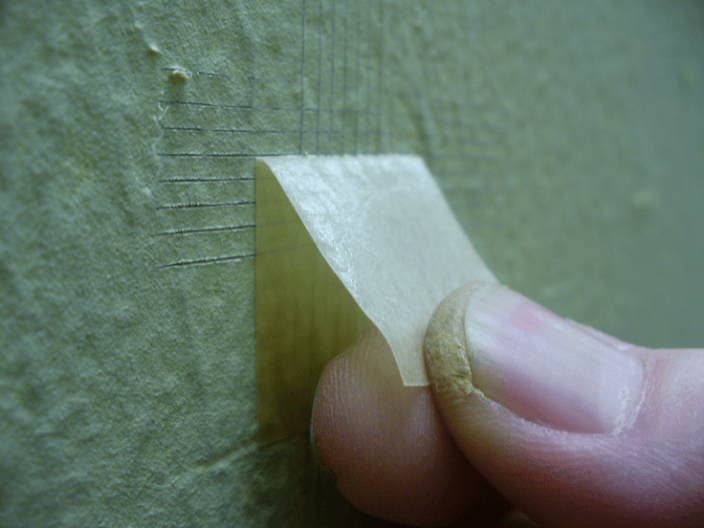
This test is simple. A crosshatch pattern is scored on the existing coating down to the substrate. Then, pressure-sensitive tape is applied over the pattern, pressed firmly on the wall and then pulled off rapidly at an angle. The amount of coating removed with the tape can then be compared to the ASTM adhesion chart to visually categorize the adhesive bonds.
- Strengths:
- Low Disturbance: only leaves a small, easily repairable mark on the wall.
- Fast and Inexpensive: doesn’t require significant time investment or special equipment.
- Useful for Screening: a quick, effective way to test for intercoat adhesion on smooth surfaces.
- Limits:
- Weak Pull Force: the adhesive on tape is weak compared to the mechanical forces a building’s facade faces; a tape test is best used to screen large areas and identify localized areas that need additional testing.
- Texture Dependent: the tape test works well for smooth surfaces. Tape does not adhere well to textured, grainy, or mineral surfaces (such as concrete) making this test less reliable on these types of substrates.
The Field Embedment Pull Test
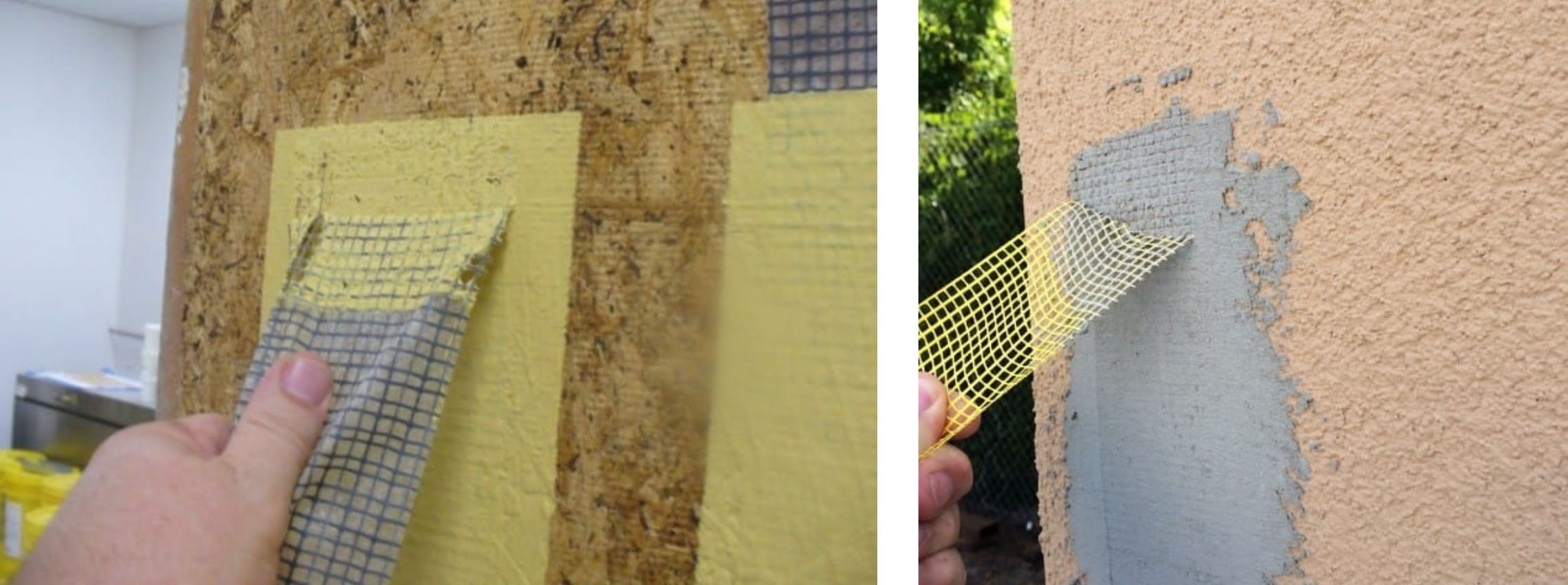
While not a formal ASTM standard, this test is practical, low-cost, and reliable in showing how a coating or skim coat will hold up under real-world stress.
Here’s how it works:
The contractor embeds a strip of fabric, like cheesecloth or StoGuard® Fabric into the wet coating leaving a few inches hanging loosely out. After the coating cures, the loose fabric tab is pulled straight out from the wall. Finally, the fabric and the wall are analyzed to see the results.
- Clean Coating Pull (Adhesion Failure): The coating comes completely off leaving the wall bare. This indicates a poor bond.
- Substrate Embedded in Coating (Cohesive Failure of Substrate): Some part of the existing material is stuck to the back of the new coating. This shows that the bond of the new coating is stronger than the original substrate.
- Fabric Pulls from Coating (Cohesive Failure of Coating): The coating stays stuck to the wall, but the fabric comes off. This means the bond of the coating is good.
- Fabric Tears (Fabric Failure): The fabric itself rips before the bond fails. This indicates a good coating bond since it is stronger than the fabric.
For thicker, cementitious skim coats, replace the fabric with a EIFS reinforcing mesh (like StoMesh®).
Like the other tests being discussed, the force required to produce failure in the test should also be considered when evaluating results of this type of test.
ASTM D4541 – The Pull-Off Test

This test is used for quality control and dispute resolution. Unlike the previous two, this test provides a numerical result.
Here’s how it works:
A small, flat disk is glued to the coating with epoxy. After the epoxy cures, the coating is cut down to the substrate to isolate the disk. Then, a hydraulic device is attached to the disk and used to apply continuous perpendicular force. This continues until a break occurs, and the peak force is recorded in psi or N/mm².
The International Concrete Repair Institute (ICRI) provides the industry standard numbers to determine if the bond passed the test. For new concrete construction it is 150 psi. For existing construction ICRI recommends a minimum 100 psi.
Tests of air and water-resistive barriers and EIFS base coats and coatings are typically compared to ASTM E2568, ASTM E2570, and ABAA minimum requirements. The minimum requirement is 15 psi (103.4 kPa) for EIFS materials per ASTM standards.
However, there is some nuance to application of these results, and the type of failure can be as important as the value of the test result. If the number is lower, but the failure comes from the substrate or coating (cohesive failure), the results for the bond may still be satisfactory. The test will have identified the weakest link in the application, but other factors may need consideration when determining if the rest result meets project requirements.
Reading the Failure Plane Is the Whole Point
Raw numbers alone don’t tell the full story. When it comes to bond failure, “where” can matter as much as “how much.” This is called the failure plane, and being able to read it properly is a very important part of bond testing.
A system can break in two main ways:
- Adhesion failure: The system breaks between two layers, such as when a new coating peels cleanly off the old one. This means the bond wasn’t strong enough. This is the least desirable type of break for a coating or overlay.
- Cohesive failure: The system breaks within a layer, like when the concrete tears apart or the fabric rips. This means the bond is stronger than the materials themselves. This is the most desirable type of break for a coating or overlay.
Knowing what to look for and how to apply the results when testing can make the difference between a successful project or one that is problematic and unnecessarily costly. Which brings us to the most important element of any effective bond testing: human expertise. Ensure that qualified, trained professionals are contracted to do the testing to maximize its usefulness. Use qualified independent laboratories for testing that will be used to verify compliance with project specifications or resolve disputes.
The Right Test Depends on the Question
Not all field bond tests are created equal. The right choice comes down to purpose, not familiarity.
To recap:
- ASTM D3359 (The Tape Test): For low-cost, quick screening of surface preparation or intercoat adhesion on smooth surfaces.
- The Field Embedment Pull Test: For practical screening or quality control of skim coat applications.
- ASTM D4541 (The Pull-off Test): The definitive quantitative test for strict specifications, formal requirements or legal dispute resolution.
For a detailed, step-by-step guide, download our Sto Tech Hotline 0714-C. If you’re planning a facade restoration project, check out our Sto reStore resources or contact our team for expert technical support here.