
Building envelopes are becoming increasingly sophisticated. And high-performance isn’t cheap. Which may lead many to believe that these weather-wrangling systems are a luxury, used only in the most lavish of buildings where no expense is spared. Nothing could be further from the truth.
In fact, because these revolutionary systems are so efficient and deliver significant long-term savings, demand for them is growing across all types of construction, including affordable housing.
That’s right, these advanced systems are ideal for affordable housing. No, correction: they’re a necessity. Let’s think about the unique demands of affordable housing for a moment. These types of buildings face some of the most demanding performance requirements. They are owned long-term and have limited funding for maintenance. The high occupancy results in frequent wear and tear. A high-performance building envelope is the obvious solution.
This article explores how these high-performance systems support durability, energy efficiency, and long-term value in affordable housing and the importance of lifecycle performance over first cost.
System Thinking as a Risk-Reducing Strategy
Historically, upfront costs were the most important factor in affordable housing construction. This led to material-by-material decision-making, resulting in a low-cost structure that was often low-performing. Insulation was sub-standard. Walls were drafty. And the operational costs were through the cheaply built roof.
System solutions perform better because all components are designed to work in harmony. System-based design leads to superior results, including:
- Reduced moisture intrusion and air leakage
- Improved energy efficiency and occupant comfort
- Minimized callbacks and repairs
Sto is a leader in systemized solutions. We design for how buildings are built, exposed, and maintained, reducing risks and improving durability. Our integrated components are designed to work together under real-world conditions. And our tested assemblies reduce uncertainty. Some features of our integrated approach include:
- Continuous insulation
- Air and water-resistive barriers
- Durable finishes engineered to work together
But how do these systems perform at scale? Our high-performance systems have been deployed in some of the most challenging urban environments. Wind-driven rain. Extreme freeze-thaw cycles. Accidental impacts. These are just a few of the challenges. As you’ll see, our systems are up to the task.
New York and New Jersey: Leading the Way
With its climate exposure, dense urban conditions, and stringent fire and energy codes, New York is probably one of the most daunting places for a building. New Jersey is likely a close second. Here are a few real-world case studies that demonstrate the building community’s confidence in our products and solutions.
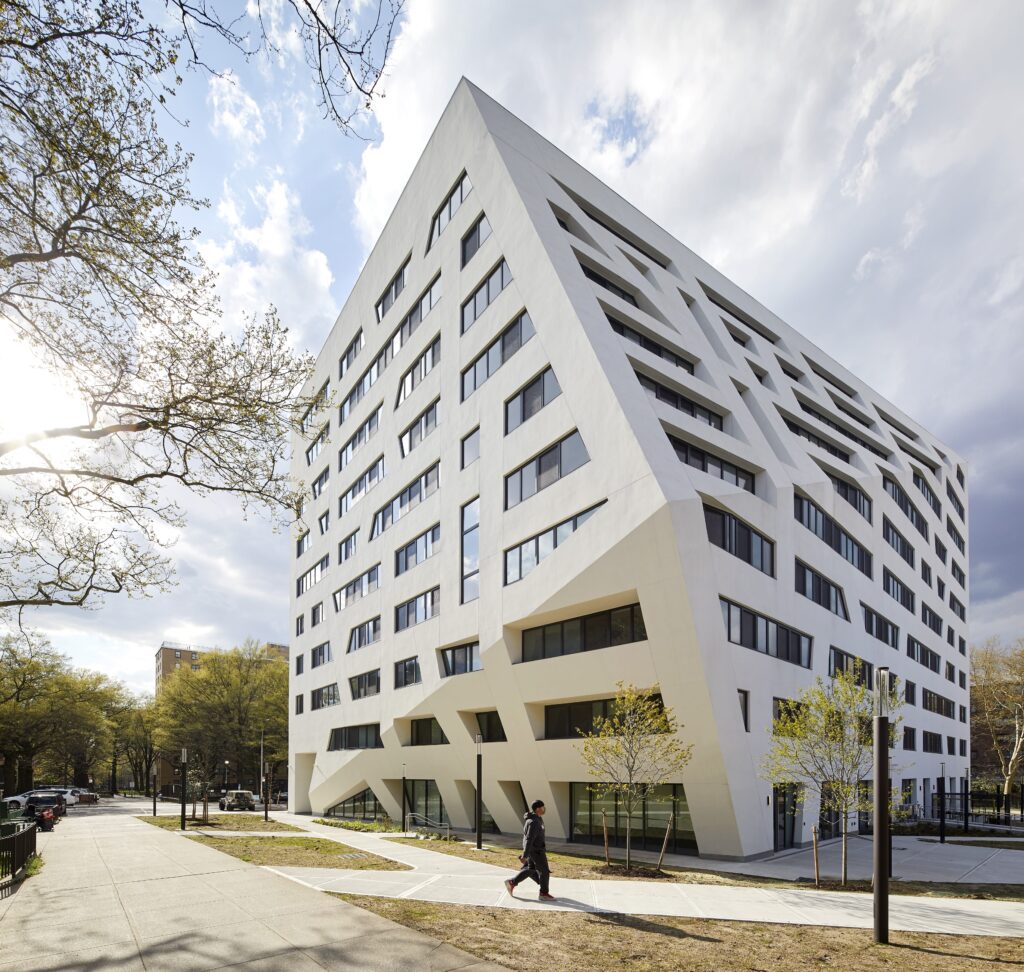
Project: Atrium at Sumner
Photographer: ©Hufton+Crow
Location: Brooklyn, NY
Building Type: Multi-Family
Construction Type: New
Constructed as part of the NextGeneration NYCHA (New York City Housing Authority) initiative, the Atrium at Sumner is an 11-story building with 132,418 square feet of affordable senior housing and a ground-level community facility of 8,309 square feet along Marcus Garvey Boulevard. Due to the project’s rigorous demands, the design team chose StoTherm® ci, a high-performance, energy-efficient EIFS with Drainage continuous insulation wall system that integrates StoGuard® air and water-resistive barrier, EPS insulation, and drainage. This tested-and-proven system will save on energy costs for years to come. It also provides exceptional design flexibility, which was essential for this unique building, featuring a dynamic yet rational geometric form punctuated by a pattern of open and solid elements.
Read the entire case study here.
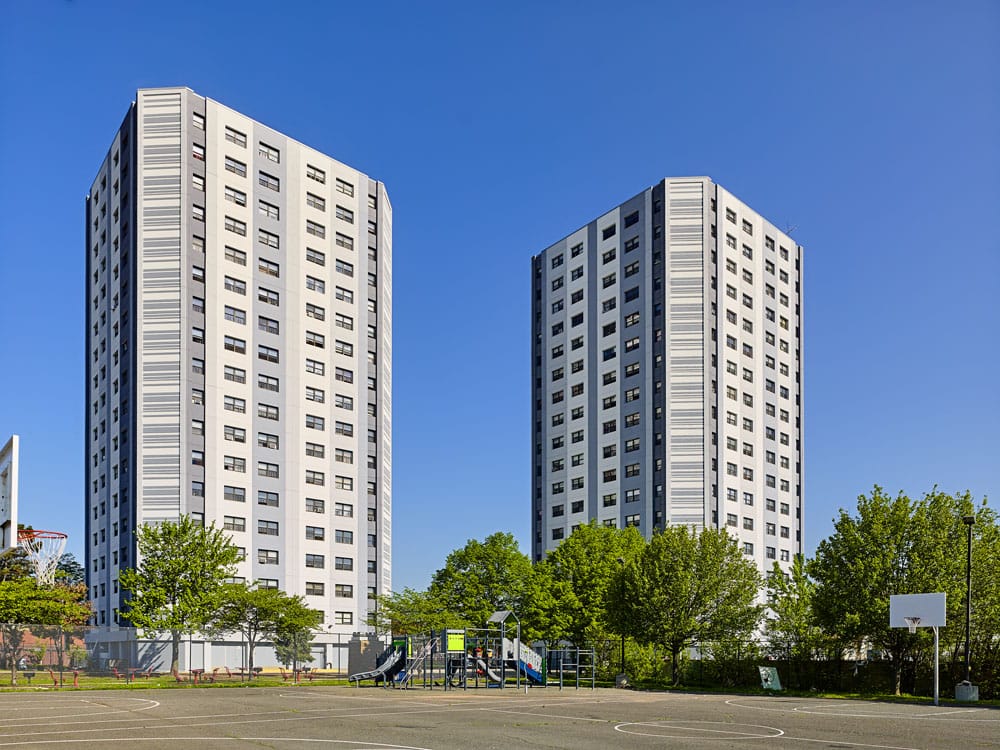
Project: Georgia King Village
Location: Newark, NJ
Building Type: Multi-Family
Construction Type: Renovation
Built in 1976, Georgia King Village in Newark, New Jersey, needed a makeover. The owners, L+M Development Partners, acquired the two 18-story affordable housing towers in July 2016. The complex was in distress, requiring improvements to individual units and to its structural integrity. Rehab priorities included installing a new facade/envelope/exterior to replace the uninsulated precast concrete facade. Heat and cold were leaking through the walls, and a livable temperature could not be properly maintained. As a result, the Georgia King Village residents were suffering.
With eight facades, multiple drops and a difficult design pattern to follow, this wasn’t an easy project. The building owner selected StoTherm® ci, a system that combines StoTherm® technology with a StoGuard® waterproof air barrier, providing air, water, and vapor control layers to protect against moisture intrusion. Reinforced basecoat and mesh, along with a durable finish, added strength to the exterior. The makeover marks the official re-emergence of the residential complex as a symbolic cornerstone in Newark’s West Ward.
Read the entire case study here.
Project: Casa Celina

Location: Bronx, NY
Building Type: Multi-Family
Construction Type: New
Casa Celina is an affordable senior housing project that was constructed on an underutilized parking lot in the Bronx, NY. StoPanel MVES ci prefabricated panels were used for the exterior façade of this 17-story tower.
The original design called for a much heavier and less energy-efficient brick facade panel, with 7” of mineral wool outbound of the AWRB. Thermal modeling and some very creative design assistance moved the job to the StoPanel MVES ci, which provided a similar R-value with reduced insulation thickness. This system was the right choice for aesthetics, schedule delivery, cost savings, and improved energy efficiency for the building.
Read the entire case study here.
To learn more about Sto’s system solutions in affordable housing applications, check out these case studies as well as Knickerbocker Commons, Ocean Village (now Averne View), 111 Church Street, and The Heritage.
StoTherm® – Revolutionizing Energy Performance
As a trusted partner, Sto delivers durability, resilience, and long-term value at scale. StoTherm® ci systems is one of our most popular high-performance solutions. This proven system contributes to:
- Reduced thermal bridging
- Improved indoor comfort
- Lower operational energy costs
- Long-term benefits for owners and housing authorities
StoTherm® ci systems also deliver design flexibility, allowing for visual variety while maintaining envelope continuity. Sto systems support:
- Brick, stone, textured, and contemporary aesthetics
- Multi-cladding designs within one compatible system
- Options for traditional, field-applied systems or prefabricated, finished wall panels
StoPanel® systems provide a systemized approach to panelized construction, offering many benefits over traditional pre-cast panels, including speed, value and superior performance. All panels are lightweight, energy efficient, durable, and are available in a wide variety of aesthetic options. StoPanel systems are the preferred choice for new construction and renovation projects.
Making Affordable Housing More Affordable
High-performance envelope systems are not a luxury in affordable housing—they are essential infrastructure. They reduce maintenance and repair costs, improve durability and service life, and enhance residents’ comfort and livability, all while delivering long-term value for owners.
As you’ve learned, Sto’s system-based approach is a proven solution in some of the most demanding affordable housing environments. We invite you to learn more about these high-performance systems and to partner with Sto early to align on performance goals, code requirements, and long-term durability.